The Lion of Judah in Christian Home Decor: Courage Carved in Wood
Some objects change the feeling of a room not because they are loud, but because they carry a story. In Christian home decor, the lion is one such image. It can suggest strength, vigilance, kingship, and courage; within Christian tradition, it can also direct attention to Christ as the Lion of Judah. A wooden lion carving brings that symbolism into daily life through a material that feels warm, grounded, and familiar.
The BGCOPPER Lion of Judah wooden wall art presents the lion’s face as a focal point for a home, study, or devotional space. Rather than functioning only as ornament, it can invite a moment of reflection: What does faithful courage look like today, and how can strength be joined with peace?

Why Christians Call Christ the Lion of Judah
The phrase “Lion of Judah” has deep biblical roots. In Genesis, Judah is compared with a lion, an image linked with leadership and royal promise. The Book of Revelation later uses the title in reference to Christ: “the Lion of the tribe of Judah, the Root of David.” For many Christian readers, the image therefore speaks of Christ’s kingship and victory.
Yet the biblical picture is richer than simple physical power. In Revelation, the announcement of the Lion leads to the vision of the Lamb. Strength, sacrifice, victory, and self-giving love are held together. This makes the Lion of Judah meaningful for a Christian home: it need not represent aggression or dominance. It may instead recall courage guided by love, authority expressed through service, and hope that remains steady during uncertainty.
A religious image does not replace prayer, Scripture, or participation in the life of the Church. Its value is more modest and personal. It can act as a visual prompt—a pause in the movement of the day that turns the mind back toward faith. Like a cross, an icon, or a favorite verse displayed at home, a lion carving can help shape an environment of remembrance.
The Natural Warmth of Carved Wood
Wood has a particular place in domestic interiors. Its visible grain and tonal variation soften a space, while carved surfaces respond gently to changing light. On a lion’s mane, those changes can make the relief appear different in the morning, afternoon, and evening. The object remains still, but its shadows reveal new details.
Carving is also a fitting medium for symbolic art because it depends on depth rather than printed appearance alone. The mane, brow, eyes, and contours of the face gain presence through raised and recessed forms. Small variations are natural to carved and finished wood, helping the piece feel connected to handwork rather than visual uniformity.
This tactile quality can complement Christian and Catholic home decor, especially where the room already includes natural textiles, books, candles, or devotional objects. Wood rarely feels cold or formal. It can make a faith-centered display feel integrated into ordinary family life rather than separated from it.

Creating a Thoughtful Prayer Corner
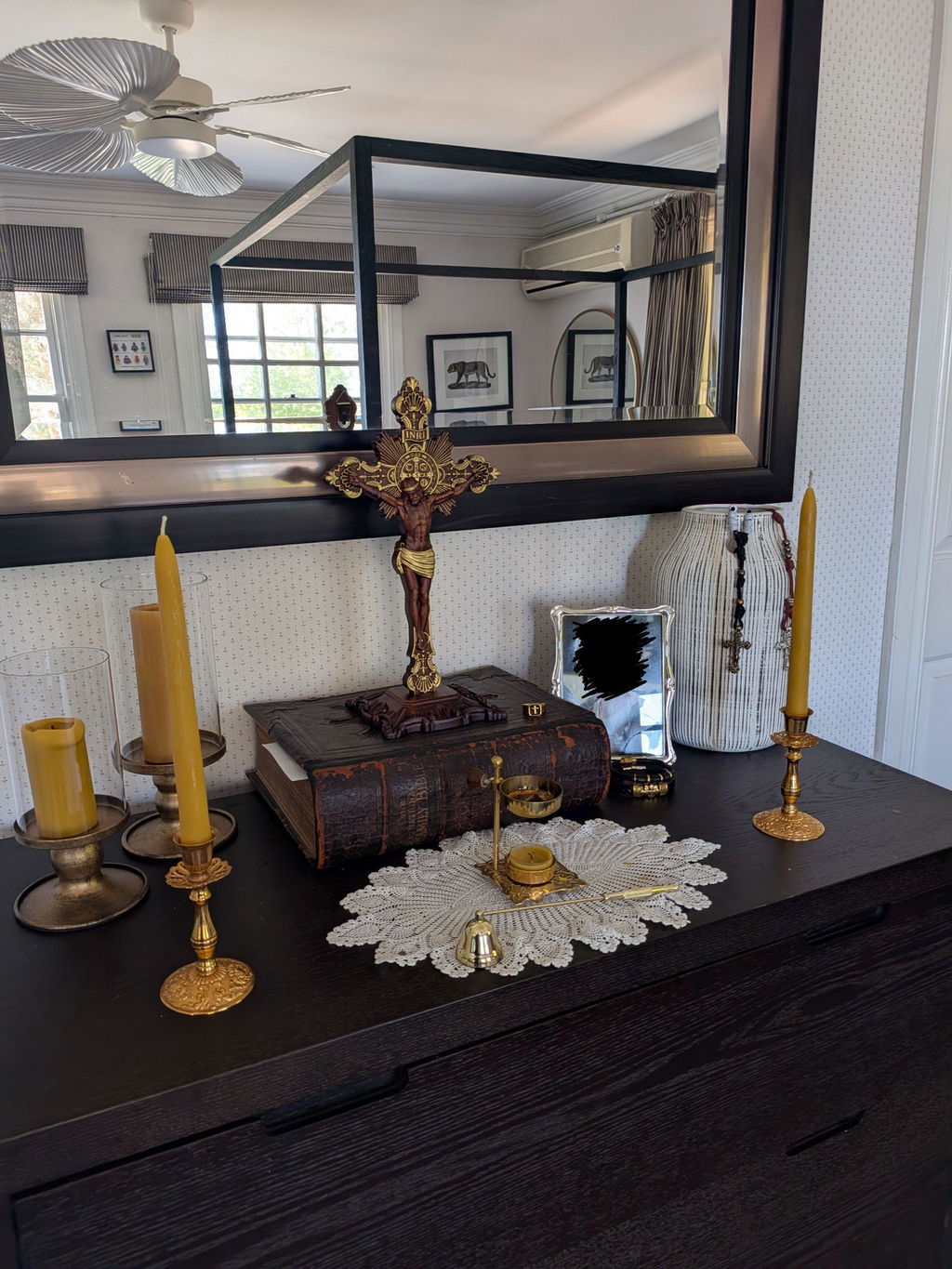
A prayer corner does not need to be elaborate. A small, intentional area can be enough: a chair or cushion, a Bible, a candle used safely, and one or two meaningful images. The purpose is not to create a perfect display, but to reduce distraction and make space for regular prayer.
A Lion of Judah carving may work well above a shelf, beside a reading chair, or near a family devotional table. Give it enough open space that the form can be seen clearly. If it shares the wall with a crucifix or other sacred art, a simple arrangement will usually feel calmer than a crowded one. Warm, indirect lighting can emphasize the carved detail without making the area theatrical.
The symbolism can also suggest a simple prayer practice. On seeing the lion, one might ask for courage to face a difficult conversation, patience in family life, or faithfulness in work. Another day, the same image may prompt gratitude for Christ’s victory and protection. In this way, decor becomes connected to habit—not through superstition, but through attentive remembrance.
Beyond the Prayer Space
The lion motif can be placed in other parts of the home while retaining its spiritual meaning. In an entryway, it can quietly introduce the values of the household. In a study or office, it may encourage moral courage, discipline, and calm decision-making. In a living room, it can become a natural starting point for conversations about biblical symbolism and the role of faith in everyday life.
Because a lion is also familiar in art and history, the piece can sit comfortably within rustic, traditional, or eclectic interiors. Pair it with restrained colors and natural textures if you want the carving to feel contemplative. Alternatively, place it against a simple contrasting wall so the silhouette and mane remain visually clear. The product page for this carved Lion of Judah wall art offers additional views for considering how its shape may relate to a particular room.

A Faith-Inspired Gift with Lasting Meaning
Meaningful Christian gifts are often chosen for a particular season rather than for novelty. A Lion of Judah carving may suit a housewarming, baptism anniversary, confirmation, ordination, birthday, Father’s Day, Christmas, or a moment when someone needs encouragement. It may also be appropriate for a pastor’s study, church office, or family prayer room.
The most thoughtful presentation is usually personal. A short handwritten note can explain why the symbol brought the recipient to mind. You might mention courage during a transition, steadfast faith through hardship, or gratitude for quiet leadership. This keeps the gift centered on relationship and prayer rather than on the object alone.
It is wise to consider the recipient’s own devotional practices and decorating style. Christian traditions differ in how they use sacred and symbolic imagery at home. A gift becomes more meaningful when it respects those preferences. If the lion image already carries significance for the person, carved wood offers a lasting and approachable way to express it.
A Quiet Symbol for Everyday Faith
The Lion of Judah is a strong image, but its place in the home can be gentle. It can remind a household that Christian courage is not merely boldness. It includes perseverance, mercy, truthfulness, and hope. These virtues are often practiced in ordinary moments: returning to prayer, caring for family, choosing patience, and remaining faithful when outcomes are unclear.
That may be the most fitting role for a piece of Christian wood carving. It does not demand attention at every moment. Instead, it waits within the rhythms of the room, allowing its meaning to be rediscovered. Through natural material, careful form, and biblical symbolism, a carved lion can become a steady invitation to remember Christ and to meet daily life with faithful courage.