Bees, Honeycomb, and Faith: A Christian Wood Carving for the Home
Some forms of Christian home decor speak through familiar sacred images; others invite reflection through the ordinary wonders of creation. A bee moving among flowers and honeycomb belongs to the second kind. It is small, industrious, and closely connected to the shared life of its hive. Rendered in carved wood, this natural motif can become a quiet reminder of diligence, cooperation, gratitude, and the goodness found in attentive daily work.
The Bee & Honeycomb hand-carved wood wall art from BGCOPPER brings these ideas together in a composition of bee, honeycomb, and floral details. Rather than functioning only as an ornament, it offers a gentle visual theme for a Christian home: creation observed with care, work carried out faithfully, and blessings received with gratitude.

The bee as a symbol of diligence and shared life
Bees have attracted human attention for centuries because their lives visibly depend on purposeful activity and cooperation. For Christian readers, that pattern can suggest virtues that are practiced rather than merely admired: patience, responsibility, service, and care for a community. The symbol need not carry a complicated theological claim. Its value can be simpler and more personal—a visual prompt to approach ordinary duties with steadiness and to remember that individual effort often supports a larger good.
Honey adds another layer of meaning. In biblical language, sweetness can evoke what is good, desirable, and nourishing. Honey also belongs to the abundance of the created world, something gathered through time and labor rather than produced instantly. In a home, the honeycomb motif may therefore encourage gratitude for provisions that are easy to overlook: food shared at a table, work completed with care, support offered by family, and moments of peace within a busy week.
The flowers surrounding the bee broaden the image further. They remind us that fruitful work depends on relationships within creation. Bee, blossom, and hive are not isolated subjects; each participates in a living pattern. That interconnectedness makes the carving suitable for a faith-inspired space without requiring it to compete with a crucifix, icon, or other explicitly devotional object.
Why carved wood feels at home in reflective spaces
Natural wood has a visual warmth that differs from glossy or highly polished decorative materials. Grain, color variation, and carved contours help the surface feel grounded and tactile. In a piece centered on bees and flowers, the medium also complements the subject: an image drawn from nature is expressed through another natural material.

Carving creates depth through raised forms, recessed lines, and changing shadows. That depth rewards unhurried viewing. From across a room, the design reads as a unified nature scene; at closer range, the smaller details become more apparent. This gradual discovery suits spaces intended for quiet attention. It can soften a wall without turning the room into a display, and it can contribute character while remaining visually calm.
Creating a prayer corner with nature-inspired Christian decor
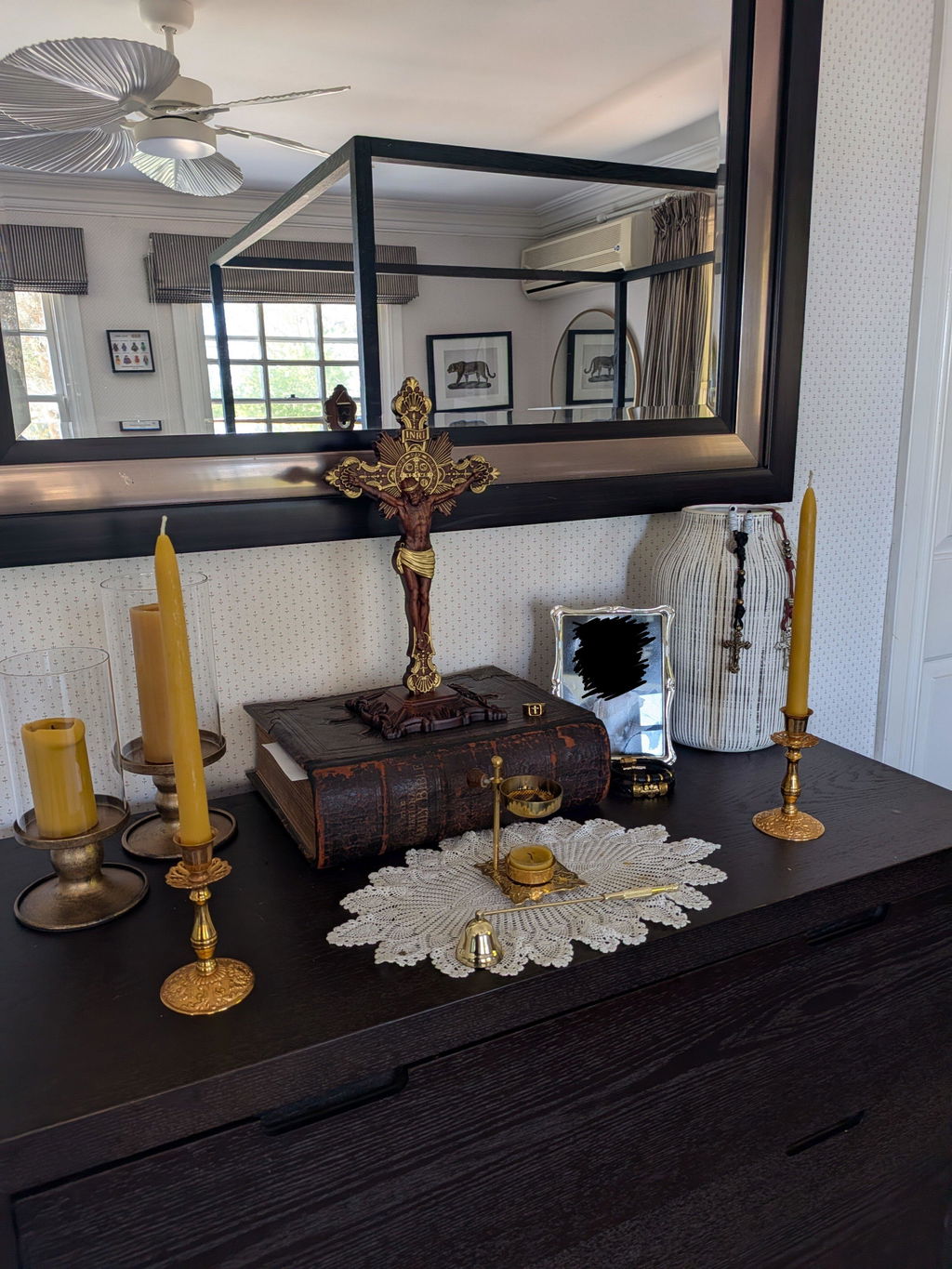
A home prayer corner does not need to be large. A chair, a small table or shelf, a Bible, and one or two meaningful objects can establish a place for morning prayer, evening reflection, or a few minutes of silence. The bee and honeycomb carving can hang nearby as a supporting image—one that connects spiritual reflection with the rhythms of work, family, garden, and season.
For a balanced arrangement, place the carving where its details receive soft natural or warm interior light. Pair it with restrained elements such as a candle, a simple cross, a small vase of flowers, or a favorite prayer book. Leaving open space around each object helps the corner remain peaceful rather than crowded. Because the design is rooted in the natural world, it can also work near plants, woven textures, or neutral colors.
The same approach extends beyond a dedicated prayer area. In an entryway, the image may set a welcoming tone centered on hospitality and shared effort. In a kitchen or dining room, honeycomb can quietly echo nourishment and gratitude. In a study, office, or craft room, the bee may serve as an understated reminder that careful work has dignity. The bee and honeycomb wood carving can therefore participate in a room’s meaning without requiring the room to be formally devotional.

A thoughtful gift for faith, home, and nature
Meaningful gifts often succeed because they recognize more than one part of a person’s life. This design may be appropriate for someone who values Christian symbolism but also loves gardens, bees, flowers, woodworking, or nature-inspired interiors. It can acknowledge faith in a gentle way while respecting the recipient’s personal style.
Possible occasions include a housewarming, birthday, wedding, anniversary, Mother’s Day, Father’s Day, or a simple expression of thanks. It may also suit a beekeeper or gardener whose daily experience already gives the motif personal significance. When presenting it, a short handwritten note can explain why the imagery was chosen: perhaps to honor the recipient’s patience, faithful work, generosity, or contribution to family and community.
For explicitly religious milestones, it is wise to consider the recipient and tradition. At a baptism, confirmation, or parish-related celebration, this carving can complement a more directly devotional gift rather than replace it. Its strength lies in making a connection between faith and daily life—the place where virtues such as diligence, humility, cooperation, and gratitude are practiced.
A quiet reminder for everyday life
Christian decor can do more than label a space. At its best, it helps people notice, remember, and reflect. A bee among flowers and honeycomb encourages attention to small acts that sustain a household and community. The carved wood adds warmth, while the natural imagery keeps the message approachable.
Whether placed beside devotional objects or simply included in a calm living space, this design offers a modest invitation: observe creation carefully, receive its gifts gratefully, and bring patience to the work in front of you. That is a quiet message, but one capable of remaining meaningful long after the room has been arranged.